
Thermalright AXP90 X36 Black
4.6Editor score
36mm total cooler height
Four 6mm heat pipes
92mm slim PWM fan
Broad Intel and AMD support
Our Htpc CPU Cooler guide compares 10 compact coolers for noise, clearance, socket support, and fit to help you choose the right HTPC with confidence today.
An HTPC CPU cooler must balance physical clearance with dependable heat transfer, quiet operation, and broad motherboard compatibility. Unlike a full-size tower, the best model for these systems needs to fit beneath a compact case or side panel without blocking memory, expansion slots, or nearby connectors. The right choice depends heavily on chassis height and processor behavior.
This guide compares ten air coolers using their published specifications, including total height, fan dimensions and speed, heat-pipe count, materials, socket support, acoustic claims, RAM clearance, and design priorities. It covers ultra-low-profile models for especially shallow enclosures, 47mm and 53mm alternatives, 65mm and 67mm designs, and taller options for builds with more generous clearance.
The selections show which cooler best fits a particular HTPC rather than treating every compact build identically. Noctua models emphasize quiet operation and broad platform support, ID-COOLING offers taller six-heatpipe and shorter four-heatpipe designs, and Thermalright covers both very low-profile and conventional tower options. Product availability and prices can change, so confirm current case clearance, socket support, and purchase details before ordering.
4.6Editor score

4.7Editor score
4.8Editor score
The comparison below makes height and platform differences easy to assess. It places each cooler according to its published design, emphasizing chassis clearance, fan format, heat-transfer hardware, and supported sockets.




The ID-COOLING IS-67-XT Black combines a 67mm low-profile body with six heat pipes, giving it more cooling hardware than most designs in its general size class. Its 4.5 rating reflects a practical balance of capacity, modern platform compatibility, and physical compactness. The 120x15mm PWM fan is the key to fitting a conventional 120mm footprint into a relatively slim enclosure.
We may earn a commission when you buy through this link, at no additional cost to you.
Heat transfer begins at the copper base and continues through six heat pipes into the fin stack. The supplied fan can deliver up to 67.58 CFM, while PWM control allows motherboard software to vary its speed according to processor demand. Automatic speed control is especially valuable in an HTPC because the system can remain quiet during menu navigation or ordinary media playback and increase airflow only when sustained processing raises temperatures.
The main limitation is physical. At 67mm tall, the IS-67-XT requires noticeably more clearance than a 36mm, 37mm, 47mm, or 53mm model. The case or side panel must provide sufficient room after accounting for motherboard components and the distance from the CPU socket to that panel. Although the cooler is designed to maintain good memory compatibility on Mini-ITX boards, its footprint should still be checked against tall RAM heat spreaders and nearby case structures.
This is a strong choice for an HTPC that needs more cooling capacity than the smallest low-profile models can provide without requiring a full-size tower. It supports Intel LGA1851, LGA1700, LGA1200, and LGA115X, as well as AMD AM5 and AM4. Buyers should prioritize it when their chassis offers at least the required 67mm of clearance and their processor may sustain noticeable workloads.
Six heat pipes and a copper base give the IS-67-XT a more substantial thermal path than common single-tower or four-pipe designs. That extra capacity is useful when an HTPC performs sustained transcoding, rendering, gaming, or other demanding tasks rather than functioning only as a media playback device.
The PWM fan can respond to the processor's temperature through compatible motherboard controls. Quiet operation during light tasks and increased airflow under load make this a flexible option for a system that serves multiple roles.
We may earn a commission when you buy through this link, at no additional cost to you.
The Noctua NH-L9x65 is one of the most balanced low-profile coolers for compact HTPC and ITX systems. Its 4.7 rating and 65mm total height make it a realistic option when a 37mm or 47mm cooler would be too restrictive but a conventional tower remains impractical. A 92x14mm fan preserves the low-profile shape while providing PWM-controlled airflow and automatic speed adjustment.
We may earn a commission when you buy through this link, at no additional cost to you.
A particularly valuable feature is its motherboard-conscious footprint. Noctua states that the cooler does not overhang the RAM or PCIe slots on most current motherboards, which means it can avoid the component conflicts that frustrate some larger low-profile designs. The mounting system covers Intel LGA1851, LGA1700, LGA1200, and LGA115X, along with AMD AM5 and AM4, making it easier to reuse across several compact builds.
Thermal performance depends on the processor. Noctua recommends this cooler for CPUs with low to moderate heat dissipation and gives examples including Intel 285K, 265K, and 245K processors and several AMD Ryzen X3D or high-performance desktop models. A low-profile cooler has less fin area and a smaller fan than a tower, so a processor with sustained heavy workloads may still benefit from additional case airflow. The included Low-Noise Adaptor can reduce fan speed further when acoustics are the priority.
The NH-L9x65 suits builders who want a conservative balance of clearance, quiet operation, and platform flexibility. It is a particularly compelling choice for a living-room PC that must remain unobtrusive while handling everyday media tasks and moderate processing demands. Confirm the 65mm case clearance, confirm that the selected processor appears in the current compatibility list, and ensure the motherboard's mounting features are compatible before purchasing.
Keeping the cooler from overhanging memory and PCIe areas simplifies assembly in tight Mini-ITX layouts. It also leaves nearby headers and connectors easier to reach during initial configuration or later maintenance.
The included NF-A9x14 fan supports PWM and automatic speed control, while the Low-Noise Adaptor offers an additional way to reduce sound. This makes the cooler practical for HTPC use where background noise can be especially noticeable.
We may earn a commission when you buy through this link, at no additional cost to you.
The ID-COOLING IS-40-XT Black is designed for compact systems that cannot accommodate a standard tower cooler. Its total height of 47mm offers more room than the very shortest alternatives, while four heat pipes and a 92mm PWM fan provide a capable air-cooling arrangement. The product carries a 4.6 rating, indicating a favorable balance of features for ITX and small form factor builds.
We may earn a commission when you buy through this link, at no additional cost to you.
The cooler can move up to 46 CFM, and its fan speed range is listed from 800±200 RPM up to 2800±10% under PWM control. This broad range allows the fan to settle at a lower speed during ordinary media playback and accelerate when the processor is working harder. The design also emphasizes RAM compatibility on Mini-ITX motherboards, an important factor when large memory modules sit close to the CPU socket.
Its four-pipe design still has limits compared with the six-pipe IS-67-XT or taller tower designs. A hot, power-hungry processor running continuous heavy workloads may require stronger airflow than a 47mm cooler can provide. The maximum fan speed can also become audible in a quiet room, even though it remains serviceable for ordinary multimedia use. The all-black appearance suits systems where the cooler is visible through a compact case.
The IS-40-XT is a good middle ground for shallow HTPC enclosures. It supports Intel LGA1700, LGA1200, LGA1151, LGA1150, LGA1155, and LGA1156, along with AMD AM5 and AM4. Its upgraded mounting kit includes a backplate, which the manufacturer describes as easier to install. Choose it when case height is the primary constraint but 37mm or 36mm is unnecessarily tight.
A 47mm profile gives builders more breathing room than ultra-short models without approaching the height of a conventional tower. That middle position often makes component alignment and installation easier in shallow chassis designs.
The PWM fan can run at reduced speed while the processor is lightly loaded. Because an HTPC may spend much of its time playing media, this operating range can be more relevant than maximum fan speed during occasional intensive tasks.
We may earn a commission when you buy through this link, at no additional cost to you.
The Thermalright AXP90-X53 Full is a 53mm-high low-profile cooler distinguished by a pure-copper heatsink and a 92mm TL-9015R PWM fan. Its 4.5 rating reflects a design aimed at HTPC, ITX, and other small systems where a moderate amount of clearance is available. The cooler measures 94.5x95x53mm and is rated for up to 42.58 CFM airflow.
We may earn a commission when you buy through this link, at no additional cost to you.
Thermalright attributes the design's heat-transfer performance to a micro-carved copper bottom, anti-oxidation processing, fine fins, and AGHP heat-pipe technology. Four 6mm heat pipes are described as resisting the inverse-gravity effects that can affect heat pipes in different orientations. The fan operates at up to 2700±10% RPM, with a listed maximum noise level of 22.4dB(A), and the overall body is specified as pure copper.
Socket support is extensive, covering Intel LGA1700, LGA1150, LGA1151, LGA1155, LGA1156, and LGA1200, along with AMD AM4 and AM5. Installation deserves attention on some motherboards. The product instructions explain that a reversed backplate and long screws may be needed when the AXP90-X backplate conflicts with rear motherboard components, and that some non-removable AMD metal backplates require removing the front bracket and using the supplied long screws.
The AXP90-X53 Full is best for a compact build that can accommodate 53mm of vertical space and benefits from an all-copper thermal path. It is a more substantial choice than the smallest 36mm and 37mm coolers, but still considerably shorter than ordinary towers. Buyers should compare the installation notes with their motherboard layout rather than assuming every backplate arrangement will work in the same way.
Using copper across the main cooling body and base can improve heat transfer compared with aluminum-only alternatives. The design also includes fine fins intended to increase the effective cooling surface within a restricted footprint.
Compact coolers often use different mounting methods depending on the socket and motherboard. Reviewing the supplied instructions before assembly can prevent conflict with rear heatsinks, integrated plates, or other motherboard hardware.
We may earn a commission when you buy through this link, at no additional cost to you.
The Thermalright Peerless Assassin 120 SE is the most powerful conventional air cooler in this group, but it is also the least representative of a genuinely low-profile HTPC design. Its 4.7 rating, dual-tower construction, six heat pipes, and two 120mm fans create a large cooling solution intended for full-size or generously sized cases. It belongs in the comparison for builders whose HTPC uses a roomy chassis or whose cooling demands outweigh compact-case restrictions.
We may earn a commission when you buy through this link, at no additional cost to you.
The heatsink measures 125mm long, 135mm wide, and 155mm high. Two TL-C12C 120x120x25mm PWM fans provide a listed maximum airflow of 66.17 CFM each, with a rated speed of 1550±10% RPM and noise level of no more than 25.6dB(A). Six 6mm pure-copper heat pipes use AGHP treatment and connect to a pure-copper base, offering substantially more fin area and heat capacity than the low-profile alternatives here.
Socket support includes Intel LGA115X, LGA1200, LGA1700, and 17XX, plus AMD AM4 and AM5. On AMD platforms, the product uses the motherboard's original backplate, which is not included. The cooler's size also makes motherboard and case compatibility critical. It may extend beyond standard Mini-ITX board dimensions, and the supplied 120mm fans add depth to an already wide dual-tower body.
This cooler is best reserved for an HTPC built in a case that explicitly supports 155mm CPU coolers and can accommodate the complete cooler-and-fan depth. It is a strong choice for a high-end living-room gaming system, workstation, or compact tower that still needs major CPU performance. It is not the answer for a slim aluminum chassis where every millimeter between the CPU and side panel matters.
The dual towers and six heat pipes provide far more surface area than a single low-profile cooler. This makes the Peerless Assassin 120 SE more suitable for sustained demanding workloads and high-end desktop processors.
The 155mm height is the decisive limitation. Measure from the motherboard mounting surface to the case panel, then allow for dust filters, insulation, and installation tolerances before considering this model.
We may earn a commission when you buy through this link, at no additional cost to you.
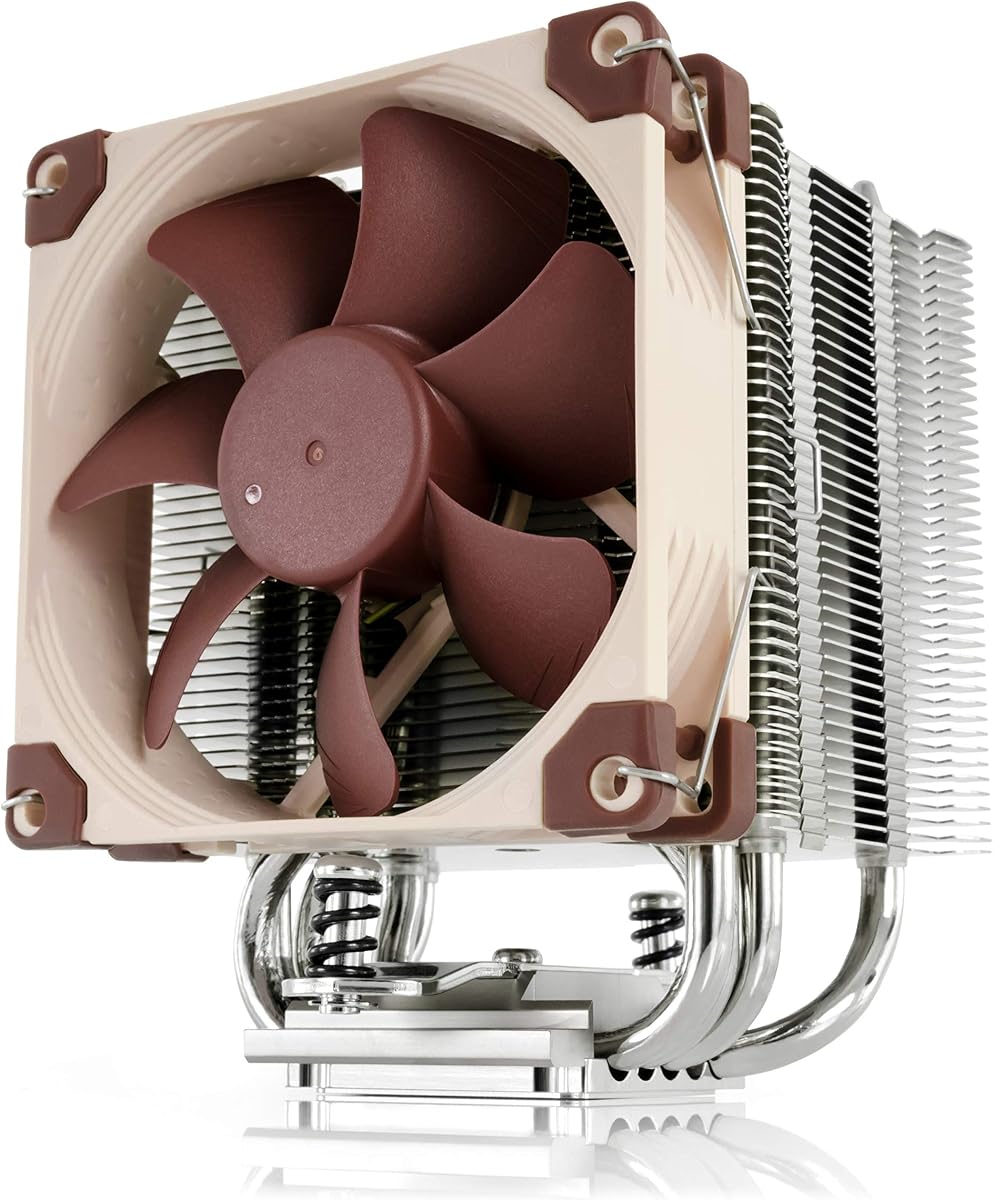
The Noctua NH-U9S earns a 4.8 rating and stands out as a compact single-tower cooler that preserves more performance potential than the shallowest low-profile designs. At 125mm high, it is explicitly positioned for HTPC, ITX, and small form factor builds that have enough clearance for a small tower but not a full-size 150mm-class cooler. Its 92mm fan also allows a relatively narrow profile.
We may earn a commission when you buy through this link, at no additional cost to you.
Cooling capacity comes from the single-tower heatsink and 92mm NF-A9 fan. The fan supports PWM, automatic speed control, and the included Low-Noise Adaptor, allowing users to prioritize quiet operation when appropriate. Noctua lists Intel LGA1851, LGA1700, LGA1200, and LGA115X support, along with AMD AM5 and AM4 with an offset mounting option for improved efficiency.
Physical integration is one of the main reasons to consider the NH-U9S over a larger dual-tower model. Noctua states that it does not overhang the RAM or PCIe slots on most current motherboards. It also comes with NT-H1 thermal compound and the SecuFirm2 mounting system. The included six-year manufacturer warranty adds confidence for a long-lived home theater or living-room PC.
The trade-off is straightforward: 125mm of height rules it out of extremely shallow cases. Even though it is sold for HTPC use, it is better understood as a compact tower for cases with moderate clearance. It is an excellent choice for a small workstation-style HTPC with a capable processor, particularly when quiet operation and long-term support matter more than achieving the lowest possible profile.
A single tower and 92mm fan offer a larger cooling assembly than the 36mm through 70mm models in the list. That extra capacity can be valuable for processors that remain active during media encoding or other sustained background work.
PWM control, a Low-Noise Adaptor, and a six-year warranty make the NH-U9S appealing for a durable HTPC build. It is particularly suitable for owners who value a quiet living-room system and straightforward long-term ownership.
We may earn a commission when you buy through this link, at no additional cost to you.
The Noctua NH-L9a-AM4 is purpose-built for the most restrictive compact systems, with a total height of only 37mm. Its 4.7 rating makes it one of the strongest choices for a shallow HTPC that uses an AMD AM4 Ryzen CPU or APU. A 14mm slim fan preserves the low-profile envelope, while the mounting arrangement is designed to preserve access to memory, PCIe slots, and nearby connectors.
We may earn a commission when you buy through this link, at no additional cost to you.
Noctua includes the NF-A9x14 fan with PWM support, automatic speed control, and a Low-Noise Adaptor. The cooler also comes with NT-H1 thermal compound and the SecuFirm2 mounting system. Its compact footprint provides 100% RAM and PCIe compatibility on ITX motherboards according to the manufacturer, reducing the chance that memory modules or add-in cards will interfere with the assembly.
The important limitation is platform specificity. This model is for AM4 rather than modern AM5, and it is most appropriate for processors with moderate heat loads, including examples such as the Ryzen 5 5600, Ryzen 7 4750G, 4650G, and 4600G. A highly power-intensive AM4 processor operating continuously at high load would have greater requirements than this compact design can ideally satisfy.
The NH-L9a-AM4 is a strong match for a dedicated media center with a very shallow chassis, especially one built around a moderate-power Ryzen APU. Its low height reduces interference with the case panel, and its quiet fan is well suited to living-room use. Confirm the AM4 socket and processor heat level before ordering, and ensure the case provides enough clearance for the complete 37mm assembly.
A 37mm profile can make a major difference in an ultra-slim enclosure. The cooler minimizes the chance that the side panel or a structural brace will interfere with the CPU cooling assembly.
The slim PWM fan can reduce its speed during playback and routine desktop activity. Automatic control and the included Low-Noise Adaptor provide additional ways to keep background noise under control around a television or shared living space.
We may earn a commission when you buy through this link, at no additional cost to you.
The Noctua NH-L12S uses a 120x15mm fan within a 70mm-high body, giving it a larger fan face than most low-profile alternatives. Its 4.7 rating indicates a refined option for HTPC and ITX systems with enough room for a slightly taller assembly. It is the successor to the NH-L12 and is built for users who value a broad 120mm airflow format without moving to a full tower.
We may earn a commission when you buy through this link, at no additional cost to you.
The NF-A12x15 fan supports PWM and automatic speed control, and the included Low-Noise Adaptor allows further acoustic reduction. Noctua's mounting system covers Intel LGA1851, LGA1700, LGA1200, and LGA115X, plus AMD AM5 and AM4 with an offset option. The package also includes NT-H1 thermal compound, and the cooler carries a six-year manufacturer warranty.
The main compromise is its 70mm height, which is slightly greater than the 65mm NH-L9x65 and substantially greater than the 37mm, 47mm, 53mm, and 67mm alternatives. Although still called a low-profile cooler, it is not intended for the thinnest HTPC enclosures. The larger 120mm fan may also require a little more care around RAM and case structures, so motherboard clearance should be verified.
The NH-L12S is a good choice for a compact HTPC with approximately 70mm of available space and a processor that benefits from the larger fan format. It is especially attractive for owners who want Noctua's quiet fan control and broad socket support without adopting a standard-height tower. For a living-room build, that combination of low-profile convenience and controlled acoustics remains its main appeal.
The 120x15mm fan can move a useful volume of air while retaining a thin profile. It is a meaningful alternative to the 92mm fans used by many of the shorter coolers in this comparison.
PWM control and the Low-Noise Adaptor allow the fan to be tuned around the room rather than running constantly at full speed. That makes the model suitable for TVs, bedrooms, and other locations where background sound matters.
We may earn a commission when you buy through this link, at no additional cost to you.
The Thermalright Assassin X120 Refined SE is a conventional single-tower cooler for medium-sized cases rather than a true low-profile model. Its 4.7 rating reflects a capable four-heatpipe design, a standard 120mm PWM fan, and broad socket compatibility. At 125x71x148mm, it is substantially larger than the purpose-built HTPC coolers but narrower than many dual-tower designs.
We may earn a commission when you buy through this link, at no additional cost to you.
Four 6mm heat pipes use AGHP technology and connect to an aluminum heatsink. The included TL-C12C fan runs at 1550±10% RPM and is rated for up to 66.17 CFM airflow, with a listed maximum noise level of 25.6dB(A). PWM control allows motherboard software to balance cooling and sound. The product is listed at a weight of 0.645kg, which is another indication that it is intended to be securely mounted in a more substantial chassis.
Intel support covers LGA1150, LGA1151, LGA1155, LGA1156, LGA1200, LGA1700, 17XX, and LGA1851. AMD support includes AM4 and AM5, with the appropriate mounting fasteners provided. The stated 148mm height means the case must be designed for a mid-tower or similarly spacious enclosure. A slim HTPC case that advertises only low-profile cooler support will not be a suitable environment.
This cooler is best for a roomy HTPC case or a living-room gaming PC that needs more cooling capacity than a low-profile design can deliver. It is a sensible middle ground between compact low-profile models and the much larger Peerless Assassin 120 SE. Check the processor's power level, the case's maximum CPU cooler height, and the available clearance around the motherboard before selecting it.
The standard 120x25mm fan format is widely supported by motherboards and case airflow configurations. It offers more face area than the slim fans used by several of the compact alternatives.
The 148mm height places this model firmly in the conventional tower category. Builders should avoid choosing it solely for its low overall width and instead verify the case's published CPU cooler limit.
We may earn a commission when you buy through this link, at no additional cost to you.
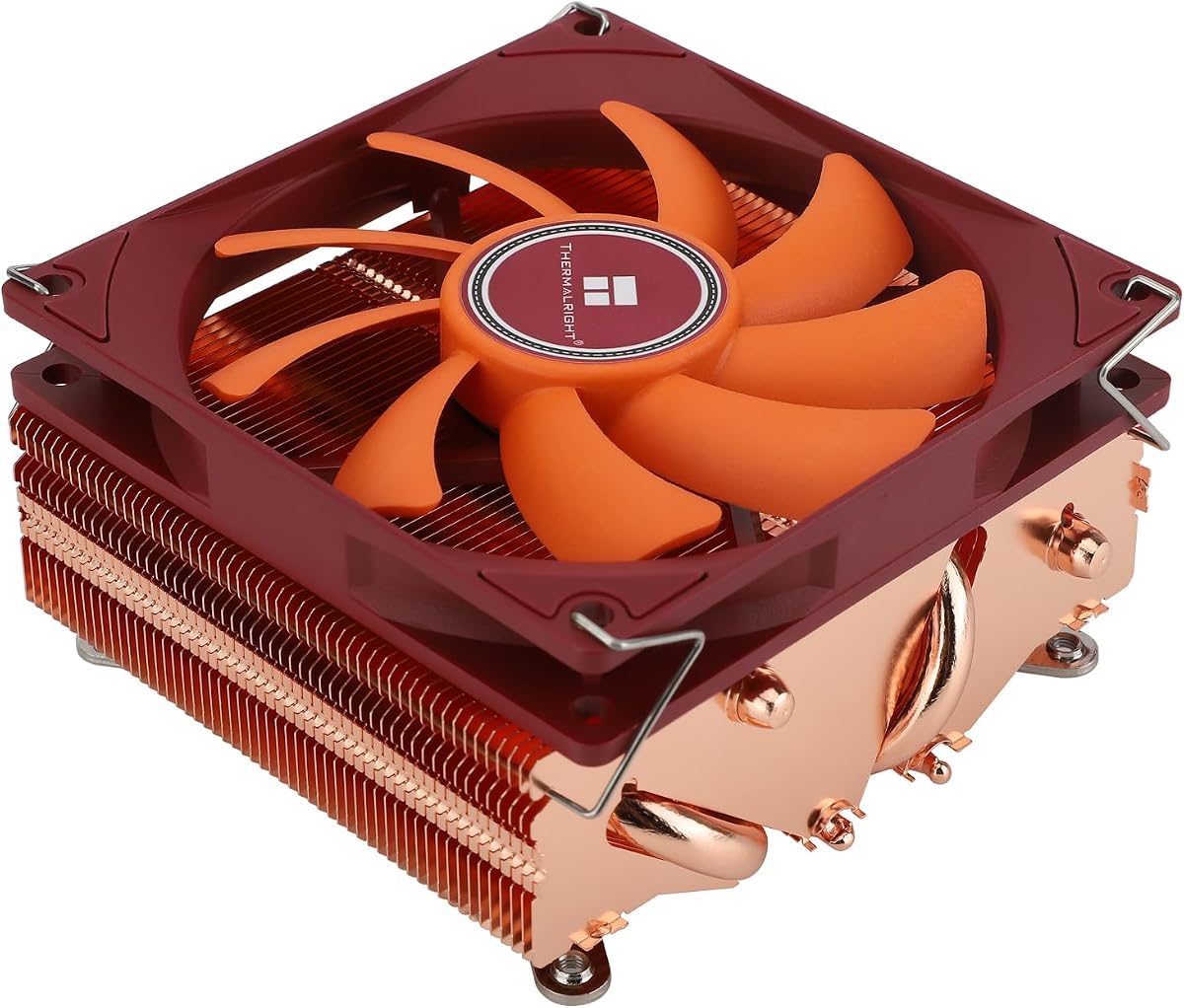
The Thermalright AXP90 X36 Black is one of the shortest coolers in this comparison, measuring only 36mm from base to top. Its 4.6 rating and low-profile design make it a practical choice for extremely shallow HTPC and ITX cases. A 92x15mm TL-9015B PWM fan provides adjustable airflow while preserving a total height that many conventional coolers cannot achieve.
We may earn a commission when you buy through this link, at no additional cost to you.
The heatsink uses four 6mm heat pipes with AGHP processing, a pure-copper base, and secondary welding between the heat pipes and fins. Thermalright lists a CPU cooler TDP of up to 95W. The fan is rated for up to 42.58 CFM, 1.33mmH2O air pressure, and 2700±10% RPM, with a listed maximum noise level of 22.4dB(A). Thermal compound is included to support heat transfer during installation.
Compatibility covers Intel LGA1700, LGA1150, LGA1151, LGA1155, LGA1156, and LGA1200, along with AMD AM4 and AM5. The 94.5x95mm footprint is designed to avoid memory limitations in compact systems. As with the 53mm AXP90-X53, however, the exact mounting arrangement and backplate interaction should be checked against the motherboard before assembly.
The AXP90 X36 Black is a value-oriented option for a compact HTPC with a moderate-power processor. Its 95W stated TDP means it is best for efficient chips and workloads that do not sustain maximum processor load indefinitely. It excels where case height is the overriding constraint, making it a strong companion to efficient Ryzen systems, APU-based media centers, and other thermally modest compact builds.
A 36mm total height opens up cases that cannot accommodate a 47mm or 53mm cooler. This low profile makes it easier to preserve a thin exterior without relocating the processor to another part of the case.
The stated 95W TDP provides a useful planning baseline. A processor running well below that level for ordinary HTPC duties should be considered more suitable than a high-power chip operating continuously at its limits.
We may earn a commission when you buy through this link, at no additional cost to you.
The right HTPC cooler begins with the enclosure rather than the processor. Measure the available space, identify the socket, estimate realistic workloads, and then balance height against cooling capacity and noise.
Choose the shortest model that comfortably handles the processor's expected heat output. Extra clearance beyond the required height does not improve cooling by itself.
Match the cooler to the highest sustained workload, not merely the light tasks used to start the HTPC. Extra cooling headroom is valuable when the same case may later receive a faster processor.
Choose a cooler explicitly listing the processor's socket. Broad compatibility is convenient, but a compatible label is not enough if the supplied mounting kit is incomplete or conflicts with the board.
Prefer a controllable PWM fan for an HTPC. Balance fan size against sound at idle, and make sure the case has enough intake and exhaust airflow to let the processor remain within its intended operating range.
Check the motherboard dimensions, memory height, and the cooler's fan overhang. Full ITX clearance claims are most useful when paired with standard-height memory modules.
Use heat-pipe count and material as screening tools, then prioritize adequate fan airflow and unobstructed case ventilation. A well-ventilated moderate design is often preferable to an oversized cooler in a cramped enclosure.
Read the mounting instructions before removing the motherboard. The right cooler is one that can be installed in the intended case and board combination without modifying or removing essential hardware.
Plan the entire airflow path before finalizing the cooler. Remove intake restrictions, keep filters clean, and confirm that the power supply or storage drive is not recirculating hot exhaust air around the heatsink.
Before installation, compare the cooler with the processor socket, read its mounting instructions, and inspect the case clearance. Install the required backplate while the motherboard is outside the case if the design requires it. Clean the old thermal compound from the processor and cooler base, apply a suitable amount of fresh compound, and lower the cooler evenly so the mounting pressure is consistent. Connect the fan to the correct CPU_FAN or PWM header.
After assembly, enter the BIOS or motherboard control software and verify that the fan speed responds to CPU temperature. Set a conservative PWM curve, especially during media playback, and confirm that the system remains stable under the most demanding tasks you expect to perform. Listen for intermittent contact, fan rub, or unusually high RPM, and check processor temperatures with the case fully closed because airflow patterns can differ from open-bench testing.
For maintenance, clean dust from the fan and heatsink fins with compressed air while holding the fan blades so they do not spin freely. Keep the intake filters and case vents clean, and avoid letting the HTPC run in a closed cabinet. If the cooler was shipped with thermal compound, follow the included instructions for whether the compound can be reused after removal. Replace damaged mounting hardware and inspect the cooler periodically for looseness, corrosion, or fan-bearing problems.
There is no universal ideal because case designs differ. A 36mm or 37mm cooler is appropriate for extremely shallow enclosures, while 47mm through 70mm models fit many compact cases. Measure the available gap and allow installation tolerance. If the case supports conventional towers, a compact 125mm design may provide more cooling headroom than an ultra-short model.
No, only if the enclosure is physically restricted. Some HTPC cases are essentially compact towers and accept a standard CPU cooler up to 140mm, 150mm, or more. Check the case specifications rather than assuming every living-room PC requires a downdraft or top-down design. The processor's heat output and the case's airflow path are equally important.
It can handle gaming when the processor and graphics settings are appropriate, but heat production varies widely. The Thermalright AXP90 X36 Black lists a 95W TDP, while the Noctua NH-L9a-AM4 is positioned for moderate-load AM4 processors. Check the processor's power limits and use undervolting or power limits if appropriate, and ensure the chassis has active intake and exhaust airflow.
Not inherently. A 92mm fan operating quietly may be acceptable, but it often needs to rotate faster to move the same amount of air, particularly under load. A 120mm fan can move more air at a lower speed, although larger fans can also produce more noise at maximum RPM. Compare acoustic figures and controllable fan curves rather than relying on diameter alone.
It can, particularly when a 120mm fan extends toward tall memory modules. Some coolers are designed to avoid RAM overhang, and others may require repositioned or shorter memory. Check the exact motherboard layout and memory-module height before ordering. Low-profile designation describes vertical size, not guaranteed clearance for every possible component combination.
Only when the cooler's manufacturer explicitly lists AM5 support and provides the required mounting hardware. Physical socket similarity does not guarantee compatible retention hardware or electrical mounting positions. The Thermalright AXP90 X36 Black, AXP90-X53 Full, and several other products in this guide list both AM4 and AM5, while the Noctua NH-L9a-AM4 is restricted to AM4.
Not always, although the ID-COOLING, Thermalright AXP90, and Noctua products described here either include paste or specifically state that it is included. Check the package contents and product listing before buying. If paste is not supplied, use a reputable thermal compound appropriate for the cooler base and apply it according to its instructions.
That depends on case airflow, processor temperature, and noise tolerance. A cooler cannot perform well if it draws only recirculated hot air, so at least one intake and one exhaust fan are useful in many compact cases. If temperatures are already stable and the system is quiet, additional fans may not be necessary, and every extra fan can add noise and power consumption.
The strongest all-around compact pick is the Noctua NH-L9x65, combining a 65mm height, wide socket support, quiet PWM control, and avoidance of RAM and PCIe overhang on most current motherboards. The Thermalright AXP90 X36 Black is the budget-oriented choice for extremely shallow cases, while the Noctua NH-U9S provides more cooling headroom and long-term support when the chassis can accommodate 125mm.
Prioritize the case before the cooler. Ultra-thin systems should start with the 36mm AXP90 X36 or 37mm NH-L9a-AM4, while 47mm through 70mm models serve a wider range of compact enclosures. For high-power processors, select a model with enough heat-pipe and fan capacity, and do not forget to plan intake and exhaust airflow around it. Socket support, memory clearance, and mounting hardware are equally important to raw size.
Product details and prices can change, so review the current listing before purchasing. Confirm the exact processor socket, the case's maximum cooler height, the complete mounting kit, and the current product details. That final compatibility check ensures the chosen Htpc CPU Cooler fits not only on paper but also in the finished living-room or compact media-center system.