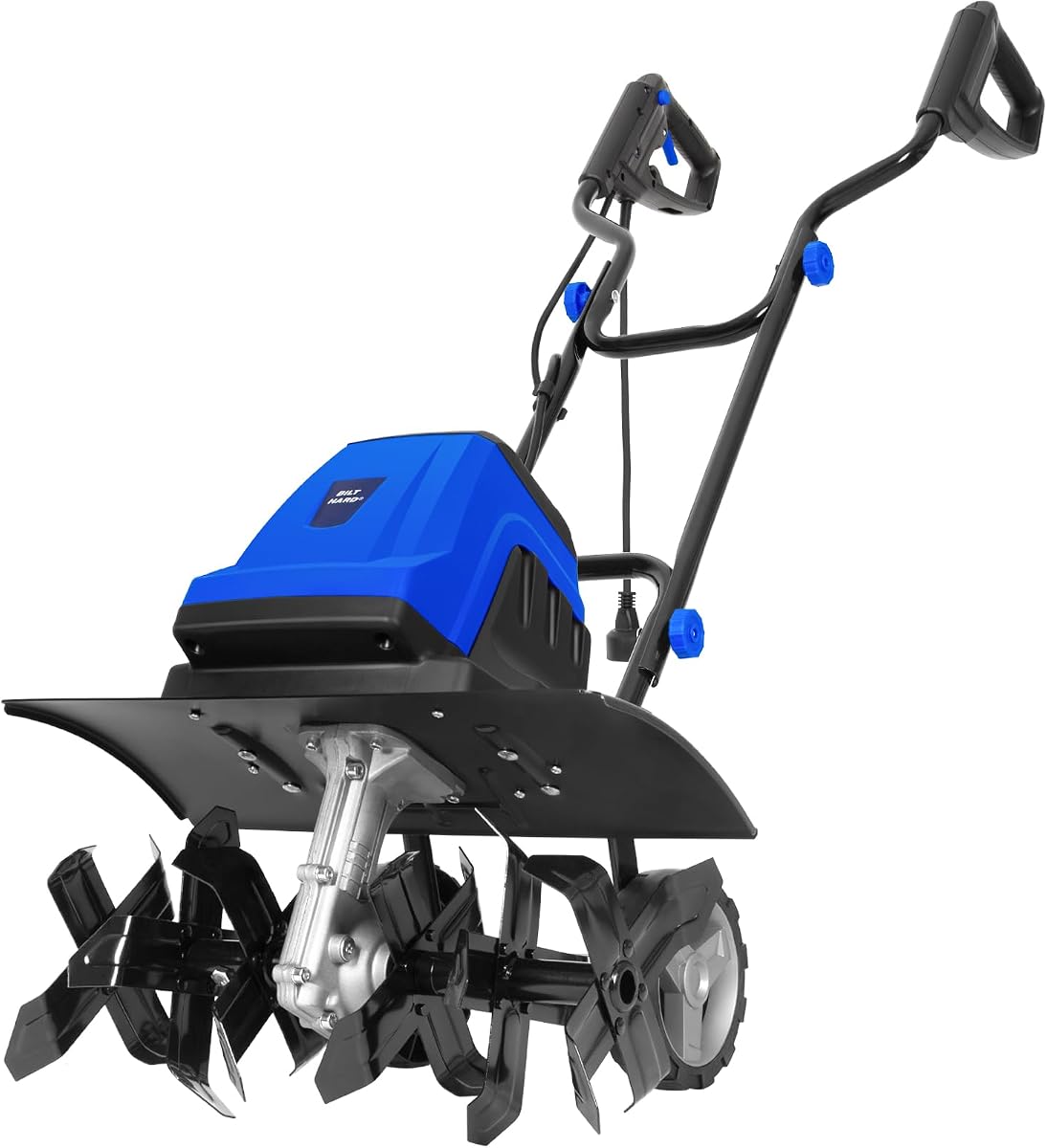
BILT HARD 18-Inch Electric Tiller
4.6Editor score
Corded 15-amp motor
Six steel tines
Eight-point-seven-inch depth
Adjustable flip-down wheels
A tiller for a small tractor can transform demanding soil preparation from a slow, labor-intensive chore into a controlled and efficient operation. The right attachment or machine depends on tractor power, attachment compatibility, plot size, soil condition, and the depth of cultivation required.
This guide compares ten options spanning tractor-mounted rotary tillers, walk-behind power cultivators, electric garden tillers, a tow-behind plow, and a PTO drive shaft. The evaluation considers documented features, operating approach, compatibility considerations, construction, and suitability for small plots or specialized soil-preparation tasks.
Each selection reveals what that product is best suited to, whether it is a complete tilling system, a compact cultivator, or a supporting power-transfer component. Customer ratings are included where available, configurations may change, and pricing should be checked with the seller before purchase.
4.6Editor score

4.6Editor score

4.2Editor score
As an Amazon Associate we earn from qualifying purchases.
The comparison below organizes each option by its practical role, working system, core capability, and best-use considerations so readers can distinguish complete tillers from cultivators, towing equipment, and essential PTO hardware.


The Gear-Driven Rotary Tiller with a five-foot width, model TG-60-Y, is the strongest overall choice in this guide for a small tractor owner who needs an efficient rotary tilling system. Its customer rating is 4.6 out of five, and the documented heavy-duty construction makes it especially appealing for regular soil preparation. The five-foot span covers substantial ground in fewer passes than compact electric or walk-behind cultivators.
We may earn a commission when you buy through this link, at no additional cost to you.
Its central advantage is a heavy-duty gear drive supported by a cast iron gearbox. The vented side gearbox operates in an oil bath, while the gearbox is supplied greased for convenient setup and maintenance. Adjustable skids regulate cutting depth, and the rear shield gives the operator control over soil mixing. Together, these features show that the model is designed around controllable, dependable cultivation rather than a minimal garden-bed tool.
There are important trade-offs. A tractor-mounted implement is a larger investment in space, transportation, and attachment setup than a lightweight electric cultivator, and the five-foot width may be excessive in confined plots. Buyers must also verify hitch, power, and clearance compatibility with their particular tractor rather than assuming every sub-compact or small utility tractor can use it.
The TG-60-Y is best for vegetable beds, market gardens, homestead plots, and other areas where a small tractor is already available and reducing passes matters. It is the top recommendation for users who prioritize a wide working width, robust gearing, and adjustable cultivation results.
The five-foot width is the standout operational feature, making this model useful for users who want to prepare long rows or broad garden sections efficiently. A tractor can also provide the traction and stability needed to maintain a consistent working pace.
Adjustable skids and a rear shield separate the basic functions of cutting depth and soil finish. These controls help the operator adapt the implement to different soil textures and cultivation goals.
We may earn a commission when you buy through this link, at no additional cost to you.
The BILT HARD 18 Inch Electric Tiller is the most approachable entry for a homeowner seeking the operating benefits of a tiller without owning tractor-mounted equipment. It carries a 4.6 customer rating and combines a corded 15-amp motor with six steel tines. The stated 19,000 RPM motor speed supports the product's intended role in small and medium gardens, lawns, courtyards, orchards, and flowerbeds.
We may earn a commission when you buy through this link, at no additional cost to you.
Four angled tines rotate at 380 RPM to break up soil, while the documented cultivation area reaches 18 inches wide and 8.7 inches deep. Flip-down wheels offer four adjustable positions, allowing the operator to vary depth for different soil conditions. The machine weighs 25 pounds and uses quick knobs with an H-shaped handle, making it substantially easier to move, fold, and store than a tractor implement.
The cord is the principal limitation. It restricts where the tiller can be used, requires a nearby outlet or suitable outdoor extension arrangement, and may be inconvenient around irregular beds. It also does not provide the sustained field capacity of a tractor-mounted rotary tiller, while the electric motor offers a different operating feel from a gasoline engine.
This is a strong budget-oriented choice for new gardeners, apartment plots, and modest raised beds. Choose it when convenience, storage, and simple depth adjustment matter more than unrestricted mobility or large-area productivity.
The 15-amp motor, 18-inch width, and six steel tines provide useful cultivating capacity without the footprint of a tractor attachment. It is particularly well suited to repeated work around small gardens and landscaped areas.
At 25 pounds, with foldable handle components and flip-down wheels, the design reduces the barriers to moving the cultivator out of storage when a job is ready. Portability is a central advantage over heavy tractor equipment.
We may earn a commission when you buy through this link, at no additional cost to you.
The Farm Cultivator Walking Tractor offers a self-propelled, two-wheel approach to compact soil preparation. No customer rating is supplied, so its evaluation here rests on the documented capabilities and configuration notes. The machine is positioned for tilling, weeding, plowing, ridging, and soil loosening, making it more versatile in task range than a basic flower-bed cultivator.
We may earn a commission when you buy through this link, at no additional cost to you.
Its compact format is particularly useful in narrow rows, greenhouses, small plots, and other spaces where a four-wheel tractor or wide rotary tiller may be inconvenient. A high-performance engine is described as providing stable power for cultivation and field preparation. The walking-tractor arrangement also allows the operator to guide the machine directly, which can provide a more controlled feel in restricted areas.
The main uncertainty is configuration. The seller states that different models and configurations are available and that final pricing is not fixed. Buyers therefore need to confirm the selected engine, dimensions, included implements, and operating requirements with the manufacturer before ordering. That extra step is necessary because the listed features describe a family of machines rather than one fully specified configuration.
This option makes the most sense for a small farm, orchard, greenhouse operator, or intensive grower who needs multiple cultivation functions in a maneuverable walk-behind format. It is less suitable for someone who wants a simple plug-in tiller or a confirmed, standardized tractor attachment without further seller communication.
Two wheels and a walk-behind layout allow the operator to guide the machine through narrow rows and confined spaces. This makes it more suitable for intensive plots where a conventional tractor would be cumbersome.
The listed applications extend beyond primary tillage to weeding, plowing, ridging, and loosening. Buyers should verify which implements are included with the chosen configuration.
We may earn a commission when you buy through this link, at no additional cost to you.
The Mini Walking Tractor Power Tiller is designed around approachable operation in compact agricultural environments. It has no supplied customer rating, but the product information emphasizes a simple control system, an easy-start engine, and an ergonomic handlebar. Those features make it a candidate for first-time users who want more capability than a lightweight electric cultivator but still prefer hands-on, walk-behind control.
We may earn a commission when you buy through this link, at no additional cost to you.
The handlebar is intended to improve grip and balance during tilling, plowing, and turning. Its compact two-wheel structure also supports easier storage, transport, and movement around smaller fields. The stated soil-loosening and aeration function is especially relevant where improved air and water penetration is needed before planting.
As with other configurable walking tractors, the absence of fixed engine and equipment details makes direct comparison difficult. The seller explicitly recommends contacting the manufacturer for configuration and customization questions. A buyer should clarify the engine specification, tilling attachments, overall dimensions, starting procedure, and service arrangements before treating the listing as a complete package.
The product suits small farms, gardens, and agricultural environments where maneuverability and straightforward controls are priorities. It may be a better fit than a full tractor for small plots, but a buyer who needs a predictable, ready-to-use package should not purchase until all configuration details are confirmed in writing.
The simple controls and easy-start engine are intended to reduce the learning curve. This is useful for operators who are comfortable with walk-behind machinery but do not want the controls of a larger tractor.
An ergonomic handlebar and compact wheel arrangement assist with balance, turning, and storage. The design prioritizes access to smaller agricultural spaces over broad-acre efficiency.
We may earn a commission when you buy through this link, at no additional cost to you.
The four-foot TG-48 rotary tiller offers a balance between coverage and manageability for owners of a small tractor. It has a 4.4 customer rating and shares several important strengths with the wider TG-60-Y: a heavy-duty cast iron gearbox, heavy-duty gear drive, adjustable skids, a rear soil-mixing shield, and a vented side gearbox that operates in an oil bath.
We may earn a commission when you buy through this link, at no additional cost to you.
The four-foot width makes it a logical choice when the five-foot model would be difficult to maneuver around narrow rows, tight headlands, or irregular plots. It still delivers useful coverage for vegetable gardens, small farms, and landscaped growing areas. The geared drive is especially relevant for users who want a tiller designed to transfer tractor power through a robust mechanical system.
Buyers still need to verify mounting, tractor power, and clearance requirements before purchase. They should also consider ground conditions, because a tiller that is effective in loose soil can behave differently when roots, stones, or compacted sections are present. The smaller width reduces some handling burdens but increases the number of passes compared with a five-foot implement.
For a small-tractor owner seeking a more compact rotary tiller than the TG-60-Y, the TG-48 is a strong middle-ground recommendation. It is especially appropriate for users who value the gearbox design and adjustable soil controls but need a narrower working envelope.
The four-foot span offers meaningful coverage while reducing the turning space required by a five-foot implement. It can be a better fit for small farms and gardens with constrained headlands.
A cast iron gearbox, oil-bath side box, and heavy-duty gear drive support dependable mechanical operation. The gearbox arrives greased, simplifying initial service preparation.
We may earn a commission when you buy through this link, at no additional cost to you.
The XB Rotary Tiller is a four-foot tractor-mounted implement intended specifically for sub-compact tractors up to 25 horsepower. No customer rating is supplied, so the product's appeal is best understood through its stated design purpose. It is presented for vegetable and hobby farmers, landscape contractors, nurseries, and similar users who need dependable rotary cultivation in a compact tractor setup.
We may earn a commission when you buy through this link, at no additional cost to you.
Adjustable shoes control cutting depth, while the rear shield controls the soil mix produced as the tines turn. Those two functions matter in professional and intensive growing environments because the operator may need to change how deeply the implement cuts or how thoroughly the finished bed is blended. The four-foot width also fits the product's compact-tractor orientation.
The main constraint is compatibility. The stated 25-horsepower ceiling should be treated as an important operating guideline, and buyers must confirm the attachment interface and other installation details. Even within that limit, tractor weight, stability, hydraulic or mechanical requirements, and operating conditions can affect safe and effective use.
This tiller is well suited to small farms, nurseries, and landscaping businesses operating appropriately sized sub-compact tractors. It offers a more specialized alternative to general-purpose compact tillers, but compatibility must be resolved before purchase rather than assumed from the broad category label.
The stated compatibility with tractors up to 25 horsepower narrows the intended use and gives buyers a clear starting point. Exact attachment and operating fit still need confirmation.
Adjustable cutting shoes and a rear mixing shield provide direct control over cultivation depth and soil consistency. These are valuable controls for vegetable beds, nurseries, and contracted landscape work.
We may earn a commission when you buy through this link, at no additional cost to you.
The Guide Gear Plow Attachment is a 48-inch tow-behind implement for lawn tractors, ATVs, and UTVs. Its 4.2 customer rating reflects a different approach from a powered rotary tiller: it uses a plow to open, turn, and work the soil while the towing vehicle provides movement. This makes it relevant to small-tractor users who want a durable ground-preparation attachment without a PTO-driven rotary system.
We may earn a commission when you buy through this link, at no additional cost to you.
The universal hitch expands the range of compatible towing equipment, while large seven-inch wheels are designed to help the implement travel over thick and uneven soil. A lockable up-or-down hitch position provides leverage and helps the operator control the working method. Heavy-duty, corrosion-resistant steel construction and a powder-coated finish are intended to protect the frame from outdoor use and rust.
A plow does not perform the same function as rotating tines. It is better suited to opening soil, creating furrows, or supporting certain planting and tillage tasks, while a rotary tiller is generally chosen for thorough bed preparation and soil mixing. The hitch's locking position also introduces leverage, so users should work at a controlled speed and understand the behavior of the plow in hard ground.
The Guide Gear is a strong option for owners who already use a compatible lawn tractor, ATV, or UTV and need a tow-behind soil tool. It is especially useful where PTO compatibility is not required and the preferred job is plowing rather than intensive rotary cultivation.
The universal hitch allows the same attachment to be used with an ATV, UTV, or lawn tractor. That flexibility is valuable for mixed-property equipment fleets.
Large seven-inch wheels and corrosion-resistant steel construction address two common concerns: movement over uneven soil and long-term outdoor durability. The lockable hitch position adds further operating control.
We may earn a commission when you buy through this link, at no additional cost to you.
The Cordless Tiller Cultivator for the Milwaukee M18 platform combines cordless convenience with a nine-inch cultivation path. It carries a 4.2 customer rating and is sold as a bare tool, meaning the battery and charger are not part of the package. For a homeowner already invested in compatible M18 equipment, that can make it a logical extension of an existing tool collection.
We may earn a commission when you buy through this link, at no additional cost to you.
The motor produces 300 watts of peak power and operates at 360 RPM, turning four hardened steel blades. The documented working capacity reaches nine inches wide and seven inches deep. For compact, hard-packed soil, the product guidance recommends a back-and-forth motion to improve blade penetration. A four-position adjustable pole system and soft-grip handle support controlled handling.
Its main limitation is the narrow working width compared with the 18-inch electric cultivator and four- or five-foot rotary tillers. The tool is therefore better suited to flowerbeds, garden rows, and small patches than broad field preparation. It is also a bare-tool purchase, so buyers without an M18 battery and charger need to acquire those separately.
This is the premium pick for users who prioritize cordless mobility, already own M18 batteries, and need a maneuverable cultivator for raised beds or compact planting areas. It is less convincing for large plots where a broader machine would reduce the number of passes.
Battery operation removes extension-cord restrictions and supports use around dispersed beds or landscaped areas. Existing M18 owners can use equipment they may already have while keeping the tiller compact.
The recommended back-and-forth technique helps the blades penetrate compact ground. This technique and the nine-inch width make the tool most practical in smaller, intensively managed planting spaces.
We may earn a commission when you buy through this link, at no additional cost to you.
The VEVOR PTO Shaft is not a tiller, but it is an important supporting option for small-tractor owners who need to connect a rotary tiller or another PTO-powered implement. It has a 4.5 customer rating and uses a well-forged Series 4 driveline with a 1-3/8-inch, six-spline connection at both the tractor and implement ends.
We may earn a commission when you buy through this link, at no additional cost to you.
The telescoping steel tube allows the shaft to compress to 31.5 inches and extend to an overall length of 41 inches. A universal joint and yokes support power transfer, while a slip clutch provides an additional line of protection. A security chain and plastic shield are also included to address safety during transmission.
Compatibility must be exact. A shaft can appear similar while differing in spline count, diameter, length, profile, or mounting style. The listed horsepower and torque figures are also operating conditions rather than a guarantee that the shaft is appropriate for every tractor or implement combination. Incorrect matching can lead to poor fitment, excessive vibration, or damage.
The VEVOR shaft is best for a buyer who has already identified a six-spline, 1-3/8-inch PTO requirement and needs a replacement or extender for compatible agricultural equipment. It complements a rotary tiller but should not substitute for one in the search for a complete soil-preparation machine.
The 1-3/8-inch, six-spline configuration on both ends is the essential matching detail. Confirm both tractor and implement specifications before ordering to avoid an unsuitable connection.
A telescoping steel tube, universal joint, slip clutch, chain, and shield combine flexibility with safety-oriented features. The adjustable span helps accommodate changing distances between tractor and implement.
We may earn a commission when you buy through this link, at no additional cost to you.
The 2 Wheel Hand Tractor is a compact walking tractor built around simple controls, an easy-start engine, and a space-saving mechanical design. No customer rating is supplied, and the listing includes a configuration notice, so buyers should not assume that every engine, implement, and dimension is identical across available options.
We may earn a commission when you buy through this link, at no additional cost to you.
Its two-wheel form makes it practical for small farms, gardens, orchards, and confined agricultural spaces where maneuverability matters. The ergonomic handlebar is intended to provide grip and balance during tilling, plowing, and turning. An easy-start system and beginner-friendly control layout make the machine accessible to users who want more capability than a small electric cultivator without operating a full tractor.
The simple mechanical system is presented as a low-maintenance feature that can reduce downtime and support long-term field performance. However, simplicity does not eliminate the need for routine inspection and servicing. Exact engine details, included equipment, starting requirements, and operating dimensions should be confirmed with the manufacturer before purchase.
This option is best for a grower who wants a compact walk-behind farming platform and is comfortable confirming specifications directly with the seller. It is less appropriate for a buyer seeking a standardized, tractor-mounted rotary tiller with a clearly published horsepower limit and established attachment interface.
The easy-start engine and straightforward controls reduce operational complexity. These qualities are useful for beginners moving from hand tools to powered walking equipment.
The compact two-wheel format supports storage, transport, and work in confined areas. It is aimed at smaller environments where a broad tractor may not be necessary.
We may earn a commission when you buy through this link, at no additional cost to you.
The right choice depends on the attachment system, available tractor power, plot dimensions, soil conditions, and how much cultivation detail you need. Start by deciding whether you want a complete tractor-mounted tiller, an independent walk-behind machine, a compact electric cultivator, or supporting PTO equipment.
A tractor-mounted rotary tiller must physically and mechanically match the tractor. Check the manufacturer's compatibility information, hitch style, required power, and operating clearance rather than relying only on the broad description of a small tractor. The TG-48-XB-OK is specifically described for sub-compact tractors up to 25 horsepower, while other models may have different requirements. Confirming the connection before ordering helps prevent expensive delays and unsafe operation.
A wider tiller covers more ground per pass, making it more efficient on long rows and broad fields. The five-foot TG-60-Y and four-foot TG-48 cover larger areas, while the nine-inch cordless model and 18-inch electric model suit compact beds. A tow-behind plow brings a different balance because width alone does not determine soil finish. Choose the width you can maneuver without repeatedly folding, lifting, or turning in tight spaces.
PTO-driven rotary tillers need a compatible tractor power source, a correctly sized shaft, and an implement designed for the available horsepower. The VEVOR shaft illustrates why connection details matter: both ends use a 1-3/8-inch, six-spline format, and the shaft adjusts between 31.5 and 41 inches. Walk-behind tractors use their own engines, while electric cultivators depend on a reliable outlet. Assess load, duration, and mobility before choosing the power system.
Tilling too deeply can bury organic matter unnecessarily, while too shallow may leave compacted soil unbroken. Adjustable skids, shoes, and wheels let an operator vary the working depth. The TG-60-Y and TG-48 use adjustable skids, the XB model uses adjustable shoes, and the BILT HARD provides four wheel positions. Rear shields add another level of control by influencing how thoroughly soil is mixed during the pass.
The right tool should match the ground you routinely cultivate. Rotary tillers work through repeated passes and are commonly used for prepared vegetable areas, while plows open and turn soil. Compact electric models are better for accessible flowerbeds and small gardens. In hard-packed soil, the Milwaukee M18 cultivator's recommended back-and-forth technique can improve penetration. Consider roots, stones, moisture, and slope before making a final choice.
Tractor-mounted equipment needs room to attach, turn, and store, while walk-behind cultivators offer more independence. The BILT HARD folds for storage and weighs 25 pounds, making it convenient for users with limited space. Compact two-wheel walking tractors can work in narrow rows and greenhouses but still need adequate room for the operator. Measure gates, pathways, turning areas, and transport vehicles before buying.
Durability matters because tines, gears, shafts, and blades encounter repeated loads. The TG-60-Y and TG-48 feature cast iron gearboxes, oil-bath side gearboxes, and heavy-duty gear drives. The tow-behind plow uses corrosion-resistant, powder-coated steel, while the M18 cultivator uses a rigid three-section handle. Look for accessible lubrication points, guarded drives, serviceable fasteners, and clear instructions for cleaning tines and checking fasteners.
Walking tractors with multiple available configurations require extra care because engine, implements, and specifications may vary. Ask the manufacturer for the exact package, dimensions, engine details, warranty coverage, and included accessories before ordering. The same care applies to any tractor attachment: review the seller's current specifications, installation requirements, and return terms. Clear documentation is especially important when a product must be matched to existing equipment.
Begin with a careful inspection of the tractor, attachment, and work area. Remove stones, roots, wire, and other debris that could wrap around tines or strike the drivetrain. Confirm that guards, pins, hitch components, PTO connections, skids, wheels, and shields are secure. Start with a shallow pass in a small section, especially when the soil is wet, compacted, or unfamiliar, and adjust depth gradually rather than forcing the implement.
Operate at a steady pace and let the machine do the work. On a rotary tiller, maintain consistent travel speed so the tines can enter and exit the soil cleanly. With the cordless cultivator, use the recommended back-and-forth motion in hard-packed areas. For a walking tractor, use the handlebar for balance and controlled turns, and avoid abrupt changes in direction that could twist the driveline or strain the implement connection.
After each use, disconnect power or shut down the engine, disconnect the PTO shaft when appropriate, and remove clinging soil from blades, tines, wheels, and shafts. Check fasteners, lubrication points, gear oil, and shields before the next session. Store electric and battery-powered equipment away from moisture, keep the battery attached only as its manufacturer recommends, and protect PTO components from dirt and damage.
A rotary tiller uses powered rotating blades to cultivate soil and is often mounted behind a tractor. A walk-behind cultivator is guided by the operator and may use either an engine or electric motor. The rotary option generally covers more ground, while the walk-behind format is convenient for smaller plots and can be moved independently.
The correct horsepower depends on the implement, its width, soil conditions, and the tractor's operating capacity. The XB Rotary Tiller is specifically described for sub-compact tractors up to 25 horsepower. Always follow the implement manufacturer's requirements and check whether the tractor can also provide stable traction and safe clearance.
It can be used if the tractor and implement are powerful enough, but clay should be worked when its moisture is suitable rather than excessively wet or frozen. Begin with shallow passes and increase depth gradually. Remove embedded stones and roots, and clean the tines frequently because compacted clay can place substantial loads on the drivetrain.
Match the tractor output, implement input, spline count, diameter, and available distance. The VEVOR shaft in this guide has 1-3/8-inch, six-spline ends and adjusts from 31.5 to 41 inches. Those dimensions describe only that shaft, so buyers should confirm the requirements of both the tractor and tiller before ordering any replacement.
An electric tiller is usually easier to maneuver, store, and control in small gardens, while a tractor-mounted rotary tiller offers much greater capacity. Electric models are also constrained by cord length or battery runtime. Choose based on plot size, access to power, and the volume of soil you regularly need to prepare.
The appropriate depth depends on the crop, soil structure, and how much preparation the bed needs. The BILT HARD is documented as cultivating to 8.7 inches, and the Milwaukee M18 model is listed to 7 inches, but those figures are maximum capabilities rather than universal settings. Work in controlled passes and avoid burying too much organic material.
Their compact two-wheel design can be useful in greenhouses, narrow rows, and confined plots where a full tractor is difficult to operate. Confirm the machine's width, turning clearance, and available implement configuration before entering the structure. The operator must also be able to move safely between plants and around supports without striking the handlebar or wheels.
Clean soil and vegetation from the tines, shield, skids, and gear housing after use. Check that bolts and retaining pins are secure, inspect the driveline and guards for damage, and lubricate the gearbox as specified. The TG-60-Y and TG-48 feature oil-bath side gearboxes, so their service instructions should be followed carefully.
The Gear-Driven Rotary Tiller with a five-foot width is the best overall choice for a small-tractor owner who wants broad, efficient rotary coverage and a heavy-duty geared drive. The BILT HARD 18 Inch Electric Tiller is the practical budget pick for compact gardens, while the Milwaukee M18-compatible cordless cultivator offers the most refined mobile experience for owners already invested in that battery platform.
Prioritize the connection before any other feature. A wide or powerful implement has limited value if it does not match the tractor's hitch, horsepower, PTO, and operating clearances. For smaller plots without a tractor, choose an independent cultivator based on width, storage, power source, and the condition of the soil. Configuration-heavy walking tractors should be purchased only after all engine, implement, and dimension details are confirmed.
Finally, compare current seller information and prices immediately before ordering, since availability, included equipment, and pricing can change. Read the operating instructions, confirm warranty coverage, and check every connection before the first pass. With those steps completed, you can select a tiller that suits the machine you own and the work you actually intend to do.